
|
|
|
|
|
Navigation
LakesnWoods.com
Nearby Communities © 2004-2024 DCMA, Defamation, Copyright and Trademark Infingement Policy
|
Old Babbitt - The Plant and Community 1920 - 1957
From Old Babbitt: The Plant and the Community 1920 - 1957
The community of "Old Babbitt" had its actual beginnings in 1865 with prospecting for gold, not iron ore. In that year pioneer and prospector Christian Weiland guided State Geologist Henry Eames through the woods from Beaver Bay on Lake Superior to Lake Vermilion to check on rumors of gold being found near the lake. Weiland pointed out iron ore outcropping when they crossed the eastern end of what is now the Mesabi Range near Birch Lake and the present site of Babbitt. In 1869, the Ontonagon Syndicate of
northern Michigan was formed to explore mineral prospects in northern
Minnesota. A year later they sent prospector Peter Mitchell and Weiland
to the area to check on Weiland's findings. Although no written account
of their trip is available, they probably followed the route from Beaver
Bay on Lake Superior to Greenwood Lake in Lake County then along an old
Indian trial along the Stoney River to Birch Lake. Mitchell's party dug
several test pits by hand, one of which in Section 20, Township 60
North, Range 12 West near Babbitt was probably one of the first pits dug
on Mesabi Range.
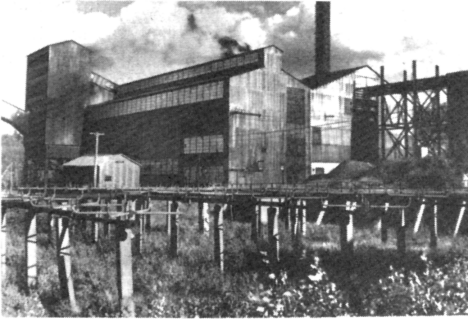
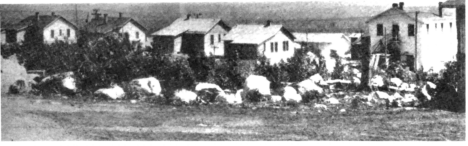
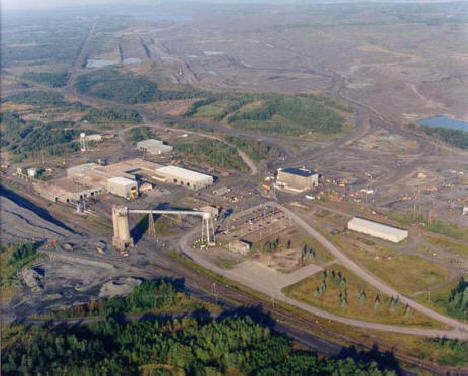
However, a new age was beginning with interest being shown in how to separate iron from the taconite ore of the Babbitt area. E.W. Davis of the University of Minnesota School of mines played the major role in developing the process of crushing and separation. The Mesabi Syndicate was formed in 1915 to finance the development. In 1919 Walter G. Swart was placed in charge of all field operations, was instructed to construct a concentrating plant at Sulphur Camp, and a new company, the Mesabi Iron Company was formed. When results proved favorable at the experimental plants in Duluth and Sulphur, Daniel Jackling and engineers searched for a suitable site for the main plant and decided on the site where the abandoned plant now stands. The search was aided by the fact that a fire in 1917 had burned all the standing and downed timber leaving a landscape covered with ashes and boulders. Early in 1920 construction began on the plant, railroad, and townsite. All work was done by horses and wagons, scrapers, shovels, and wheelbarrows. There were no trucks or bulldozers or other heavy equipment.
Late in 1921, just before the plant was to become operational it was found that the 60 to 61 percent iron sinter product was not good enough for steel producers who were interested in 64 to 65 percent iron. The plant, however, went into operation on June 21, 1922, and the first shipment was made October 1, 1922. Quality of the sinter product remained an insurmountable problem and although production costs were reduced and the product was improved, mining in the pit ceased in May, 1924, and all operations ended on June 10, 1924. All the investments, dreams, development, and construction came to an untimely end in a short two years. The Babbitt plant was abandoned, 245 employees left for other jobs, and the mining town became a ghost town by the fall of 1924. The Remaining Community 1924 - 1955 With the closing of the plant in June of 1924, an abrupt and major change took place in Babbitt. By fall most employees had left and a crew of about ten men and their families totaling 30 to 40 people was all that was left.
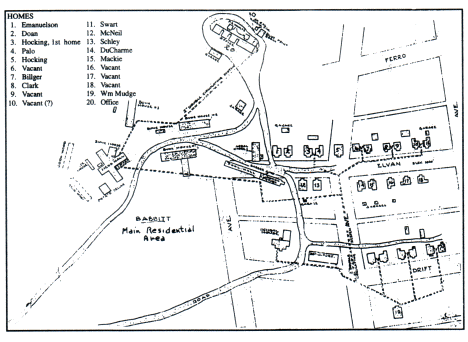
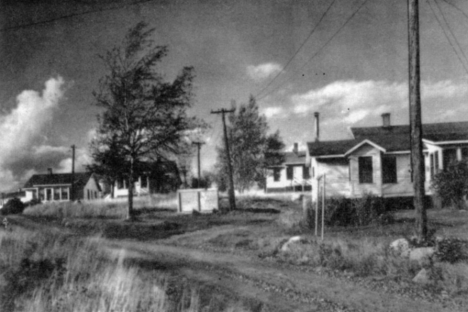
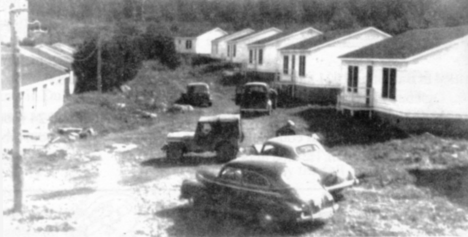
Three residential areas had been constructed in 1920 composed of the main townsite of 25 dwellings up the hill from the plant and two additions. One addition, Pleasant View was located across the road from the plant. It consisted of 16 separate houses for eight men each, a cookhouse, and mess hall. The houses cost about $4000 each. Larger houses were built for the mine superintendent and the plant supervisor. West Babbitt of 28 homes was located on the railroad southeast of the plant. All the homes in West Babbitt were built by the employees with materials supplied by the company at cost. Both Pleasant View and West Babbitt were abandoned at the closing of the plant and the remaining workers lived in or moved to the Babbitt townsite on top of the hill. Company homes were all one story with no basements. A standard home consisted of two bedrooms, kitchen, living room and bath with tub and no shower. Water for the bath was heated by the wood burning kitchen stove, stored in a tank, and then piped to the bathroom. A glazed porch finished off the front of the house. When larger buildings were needed, two homes were joined and for the office, farthest up the hill, five homes were joined by a vestibule. The main townsite, (referred to as Babbitt from now on), had a two story dormitory for single men.
It had 24 rooms with 48 beds, two baths,
a clubroom with pool table, basement, and a heating plant. There was a
two story general store with a basement and living quarters upstairs for
the storekeeper, I.B. Marshall. A community hall nearby had a small
stage, dance floor, barber shop and movie screen.
With the closing of the plant in 1924, the remaining workers and their families made up a close knit small community which settled into a routine living that would last 25 years.
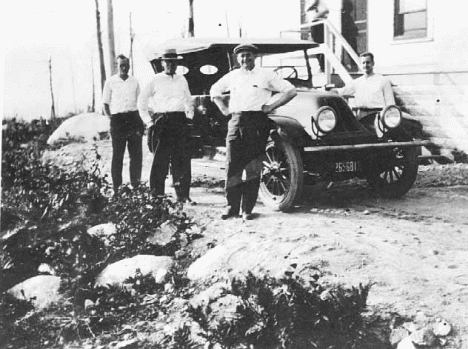
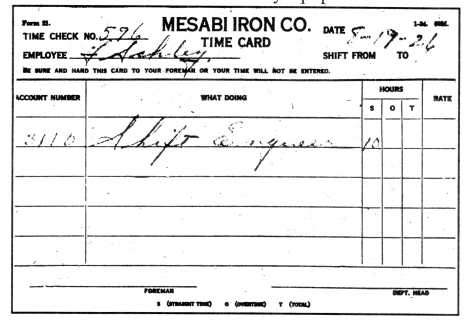
The duties of the remaining workmen consisted of watchmen's duties over the remaining plant and outbuildings and daily maintenance over the plant, the generator, water system, and the homes.. Although the pay was small, they were assured of work and a monthly check during the trying times, of the 1930s depression.
In the 1920s groceries arrived by a weekly train after Marshall's grocery store had closed and then were purchased in Embarrass or Ely after train delivery stopped. Milk, cream, eggs and vegetables were readily available from Finnish farmers in the Waasa and Embarrass areas. Families also had their own vegetable and berry plots. Ice was cut during the winter at Birch Lake by the maintenance and delivered to the home ice boxes all summer. Coal was delivered in the winter and homes had coal or wood burning heating stoves in the living room since there were no basements. Electricity was produced by a diesel generator in the plant below the town and was shutoff for the night at eleven o'clock. From then on light was furnished by kerosene or gas lamps. Later as an economy move the power was not turned on until 4:00 pm in the winter and 7:00 pm in the summer. However, on Mondays power was on from 8:00 am until noon so the women could wash clothes.
Church services were held in the community building until the plant closed in 1924. Sunday school classes were then conducted by Mrs. Swart, Mrs. Clark, and Mrs. McNeil in the school. Children dressed in their Sunday best to attend classes. Dr. Paul J. McCarty was hired as company doctor but left Babbitt for Ely in the 1920s with his wife and children, Paul, Winifred, and Eugene.
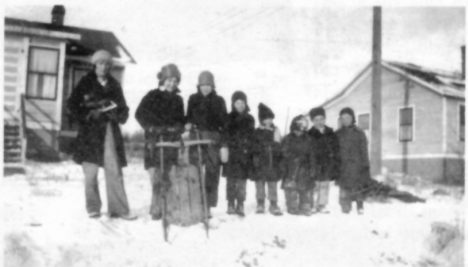
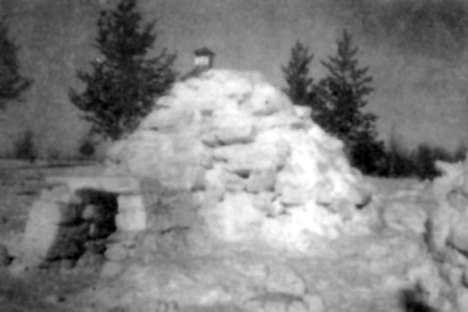
The only street was not paved so conventional activities such as roller skating and hopscotch were not possible. Many of the children's activities were centered on the woods in their backyards, the school, the abandoned empty buildings, and the long hill down to the plant which lent itself to bike riding in the summer and sleds in the winter. Boys played in the empty plant buildings until they were locked in 1939 when Reserve Mining took over. They often walked on top of the wood enclosed water line to Birch Lake and swam on the beach. Picnics were held for all at "Oscar's Place" which had a small store and picnic tables at the lake. In the winter, snow was shoveled from Argo Lake for skating and the usual snow forts, snowmen, and igloos were common.
Card and board games such as Monopoly and
Chinese Checkers were popular in the evenings. Battery powered radios
provided programs such as Orphan Annie, Jack Armstrong, Amos and Andy,
and later Jack Benny and Burns and Allen. The popular soap opera "Stella
Dallas" was a favorite daytime program. The Families Nellie Doan Bubash's family moved to
Babbitt in 1921 during the construction period for the plant. She was in
the fourth grade in the new school and recalls the rowdy crowd of
workers who lived in the dormitories and ate in the large mess hall.
Heavy drinking and fighting were common with the men. It finally reached
the point where the company hired a policeman to reduce the problems. In
one incident a man was shot near the mess hall. It was the same day that
cooks usually made apple pie and homemade ice cream for all the
children. The children came for their treat and ignored the body at the
end of the table that was awaiting the undertaker from Ely.
The McNeil family moved to Babbitt from
the Scott-Lenont potato farm which was located on the flat ground at the
present site of the city of Babbitt. Dr. C.B. Lenont had purchased the
land in 1920. The farm produced cobbler seed potatoes for many years
which were shipped to the south in the winter for early crops there.
During the 1940s the production was changed from potatoes to wheat and
oats.
Some families lived for a short time
only. They included William Mudge, mine supervisor during active mining.
Einard and Tillie Mackie and children Joyce, Duane
School Days
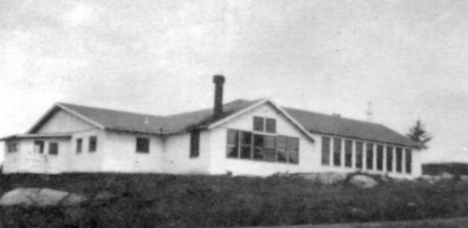
During the plant and town construction, a three-room
schoolhouse was also built. Eventually one room was used as a classroom,
however, the second was a play-gym, and the third was for storage and
wood working shop for the boys. A playground located across the road
from the school contained three swings, a trapeze bar, two sets of rings
and a sliding board.
During the construction period 245 employees were
working and they and their families totaled about 400 persons. School
District 83 was organized in 1921 and in 1923, 66 students were
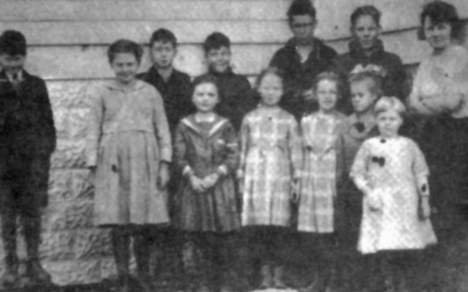
enrolled. The first school class was held in 1920 with 11 students and
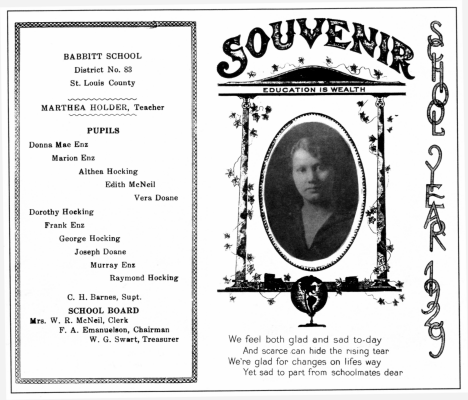
Clare Eckrem as teacher. Early records are not clear but Clydene Rice (Gottschald)
followed for two years in 1927-28, as did Marthea Holder in 1929 and
1930. She lived in her own apartment in the converted office building
and paid a dollar a day for room and board. Clydene later married
Raleigh Gottschald who was on the early office staff in the early
1920s.
One teacher handled all grades from first through eighth
although at times there were no students in some grades. After the plant
closed the biggest classes numbered up to about a dozen students but in
1937 there were only two Bob Emanuelson and Joyce Mackie. Bob in the
fourth grade and Joyce in first.
The school was a center of activity for the children.
Holidays were celebrated with programs and graduation from eighth grade
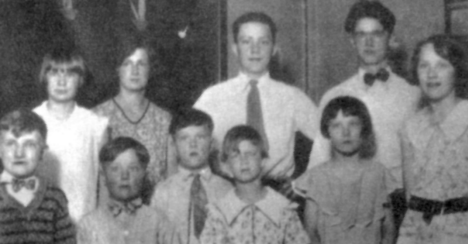
marked the end of schooling in Babbitt. During the late 1920s and early
1930s, graduation ceremonies and picnics were held to mark the
occasion. Students then had to choose the High School they wanted to
attend. Some went to Virginia but most chose Ely as it was 20 miles
closer. The pupils boarded out in Ely family homes and all costs were
born by the Babbitt School district. Whenever possible they were picked
up by parents on Friday to return home and then brought back again on
Sunday. The parents combined the taxi service with an
opportunity to shop, buy groceries, and attend movies at the Opera House
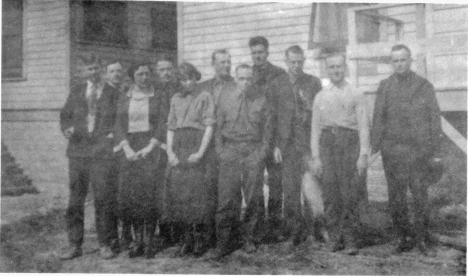
(now the bowling alley), the Elco and later the State and Ely Theaters. 1920 Clara Ekrem from Tower and Jean Johnson with 11
students
The late 1940s saw the beginning of the end for "Old
Babbitt". From 1944 to 1951 Reserve Mining moved slowly toward building
a large scale taconite processing plant, the first in the world. In 1951
it was announced by Oglebay Norton Mining that a mine would be opened at
Babbitt, a crushing plant constructed, a railroad built to Silver Bay on
Lake Superior and a new town on the former Scott-Lenont potato farm
below the old plant site. From Old Babbitt: The Plant and the Community 1920 -
1957
|
|
|
|
|
|
© 2004
LakesnWoods LLC All Rights Reserved |
|
|
|
||
|
|