|
Navigation
LakesnWoods.com
Home
Page
Contact Us
Privacy
Minnesota History Shop
Visit The Minnesota History Shop
www.minnesotahistoryshop.com
Historic maps
Historic books
Historic framed art
Historic
postcards
Clothing with historic
images
And much more!!! |
Suomi Guide:
Location
Geography
Demographics
History
Government
Post Office
News
Weather
Street Map
Events
Attractions
Recreation
Lakes
Health Care
Schools
Churches
Media
Motels
Resorts
Campgrounds
Businesses
Aerial Photo
Topographic Map � 2004-2022
LakesnWoods LLC
All Rights Reserved
DCMA, Defamation, Copyright and Trademark Infingement Policy
|
WANTED! Do you have photos, historical accounts or
other items pertaining to the Suomi area? Would you like to
share this historical information with the world? ItascaWeb
would like to publish your Suomi photos or historical accounts
on this website. Original materials can be returned and your
privacy will be respected.
Contact us |
|
Suomi Minnesota Community Guide
Location:
Population:
Unincorporated
Geography:
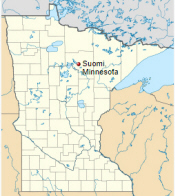
Suomi is an unincorporated community in Itasca
County, Minnesota, in Deer Lake Unorganized territory..
The community is located northeast of Deer River;
along Itasca County Road 48 (CR 48). Nearby places
include Marcell, Deer River, and Cohasset. State
Highways 6 (MN 6) and 38 (MN 38); and County Road 19 are
also nearby.
The center of Suomi is generally considered at the
junction of Itasca County Roads 48 and 253. Little
Bowstring Lake and the Bowstring River are in the
vicinity. Suomi is located 13 miles northeast of Deer
River; and 27 miles northwest of Grand Rapids. Suomi is
12 miles south of Marcell.
The community is located within the Bowstring State
Forest and the Chippewa National Forest. Suomi Hills
Recreation Area on State Highway 38 is also nearby.
From Wikipedia, the free encyclopedia
History:
Suomi means Finland, and it was a Finnish land agent,
Mr. Havela from Duluth, who interested people to settle in this area around
Little Bowstring Lake beginning in 1916. Because the people who settled
here were almost all Finnish and the area reminded them of Finland, they
called the community Suomi. The townships that make up Suomi were originally surveyed
around 1870. The first homestead dates back to 1873, with most early homesteaders
being more interested in the timber than in settling the land. However,
seven homestead claims were proven from 1875 to 1913, including Jeremiah
Miller, George Russell, Richard Boan, Robert J. Clark, Saul Estes, Charles
Murphy and Orlando Walker. Other early settlers were Robert O'Connor,
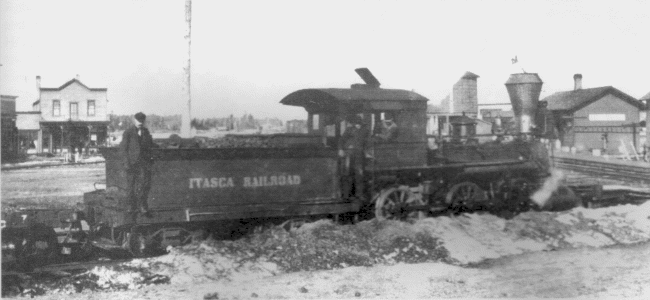
the Willis, the Dells, the Lindens, the Quiggs, amend the Morrisettes. In 1898 the Itasca Railroad, later called the Minneapolis
& Rainy River railroad or "Gut & Liver", was built as far as Bowstring Hill
and extended to Smith Lake. After the timber was cut in this area, the railroad
was pulled up in 1904 and rerouted north to Jessie Junction, later called
Alder. There was a small station at the south end of the Little
Bowstring Lake called Elbow. It was a little shack that was used as a
railroad station for the freight trains with a passenger car or two.
|
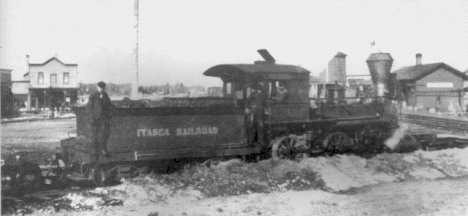
Trains were an important mode of transportation
in the Deer River area.
Here is an Itasca Railroad engine getting ready to go to Suomi. |
The first of the Finnish arrivals in 1916 were Otto Salo,
Edwin Juntunen, Edward Heikkinen, Oscar Maki and Richard Wierimaa. Other
names of these pioneers are Kela, Kolu, Maki, Mattson, Huju, Filpus,
Anttila, Koivulas, Rikalas, Saari, Jack Maki, Wuorio, Makila, Hokkanen,
Forsman, Kokko, Wehvilainen, Ranta, Tanninen, Aho, and Rutanen. Most
were immigrants to the United States. In 1967, at the time Suomi's 50th anniversary, Minnie
Juntunen described her journey with a small daughter from Alexandria to
Suomi in 1917. At Suomi she joined her husband, and she described her
feelings as she sat on the hill where they would build their home. "I
sat on the pile of hewn logs and looked around me. Our cow was chewing
her cud, the chickens were cackling, and the roosters crowing. How
homelike it already felt!" Edwin said, `Now we are here in the
wilderness, only we three far from any other people.' I won't deny we
had tears in our eyes, but then we remembered our dream of someday
claiming some homestead property and owning our own home. Our dreams had
been fulfilled." Their second daughter, Mildred, was the first baby born
in that community. Mildred and her husband, Peter Hanson, still live in
Suomi. Ailie Maki Mackley's story is typical of the immigrant
families. She was eight years old when she came to Minnesota from
Finland, first to Hibbing and then to the Suomi community. Her father
had arrived in Hibbing four years earlier and then sent for his family.
It was 1917, the beginning of World War I, and ships were being sunk by
mines. Aili remembers how scared everybody was on that long ship journey
across the ocean. There was a one-week wait at Ellis Island before she,
her mother, and siblings made the journey to Minnesota and joined her
father and other relatives already living in Hibbing. Her father
purchased land in the Suomi community and quickly built a log house. He
returned to work in the mines, but it was during this time that, due to
labor issues, Finns were blacklisted from the mines, so he returned to
Suomi to farm amend also do some logging. There were no cars and the M&R
train was the only transportation � said it took three days for the
cattle to reach here, said Ailie. My brother and cousin rode along in
the boxcar and milked and fed the cows. The M&R train was the main mode of transportation in
the early days. If a person had business in Deer River, they had to stay
overnight and return on the train the following day. These pioneers
carried large loads to their homesteads. People also walked long
distances and used the rivers and lakes. Residents from Big Bowstring Lake used to come by boat
along the creek, row across Little Bowstring, and camp on the shore
overnight before starting the walk to Deer River the next morning. For
them, it was a two-day trip to town and another two day trip homeward.
The Christies of Big Bowstring recall that when they first came to the
area, they left their team of horses in Deer River until winter but
brought their cow along with them in the boat across Little Bowstring
Lake and down the creek to their property. Everything went smoothly
until they tried to remove the cow, who became frantic and capsized the
boat.
The first automobile trip made to Suomi is believed to have been made in
1918, when the only road was the railroad grade. Waino Anttila and Emil
Hokkanen were working together when they heard a commotion that Emil
thought to be a chimney fire. It proved to be an old Model T Ford filled
with men who had come to inspect the prospective school site. The driver
of the car, Victor Wicklund of Jessie Lake, built the school. The first
teacher of the Grave Lake School was Fanny Niemi. The pupils who
attended the first term of school were Arthur and May Wierimaa. Rudolf
and Jalr Kela, Reuben Heikkinen, Saimi, Ailie and Emil Maki, Inga, Ilma,
Irja, Matt, and occasionally Iivo Saari.
|
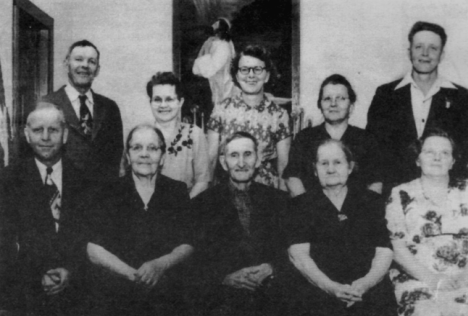
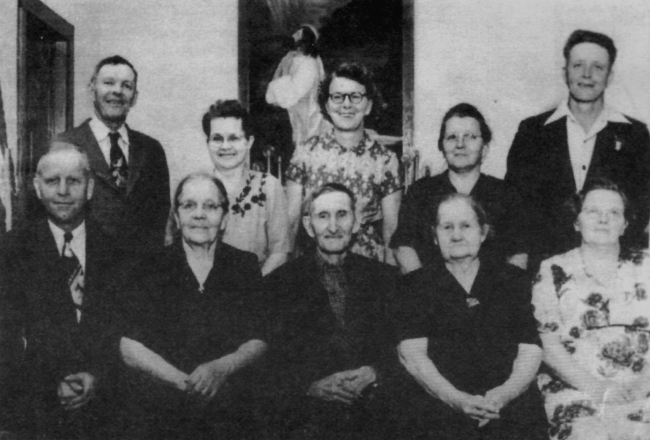
These Suomi pioneers were early members of the
Suomi Evangelical Church. Seated, left to right: Jack Saari,
Elizabeth Saari, Gus Saari, Maria Heikkinen, Ida Salo; Back row:
Edwin Juntunen, Minnie Juntunen, Inga Aho, Ilo Huju, Ivo Saari -
Deer River Area Centennial History |
"In those early days, the children spoke Finnish and as soon as school
started the kids started to teach Finn to the teacher," said Ailie
Mackley. Finnish was the language on the playground though the teacher
tried hard to make them speak English. Students walked to school. Some
walked home for lunch, and others brought their lunches.
Originally Suomi was in District #5, but later they organized their own
District #13, electing their own school board. In 1933 it became a part
of the Grand Rapids school district. Miriam Payne recalls her high
school days rooming with two others in one room in Grand Rapids. After
coming ho for weekends, they returned to their small rooms with a week's
supply of food. There was a "stinky little kerosene burner- where they
were able to cook potatoes, she said. Later students attended the Deer
River School and stayed at the dormitory. Many of these determined young
women attended college in Bemidji and became teachers. Corrine
Wehvilainen was the last teacher when the Grave Lake School was closed
in 1949. By 1950, students rode the bus to school in Deer River. The Suomi Evangelical Lutheran Church was organized on
July 13, 1918, at the Heikkinen home. During the influenza epidemic of
1918, Jaffet Heikkinen and his two sons, John and Emil, died within the
space of nine days. They were buried on the farm but transferred to the
cemetery when it was begun in 1920. The first confirmation class was
Saimi Maki, Ilma and Inga Saari. The first Suomi bride was Ida Heikkinen,
who married Otto Salo. The first wedding dance was held at the Grave
Lake School after the home wedding of Impi Saari. The Suomi church
building was completed in 1940, and the first wedding was of Mildred
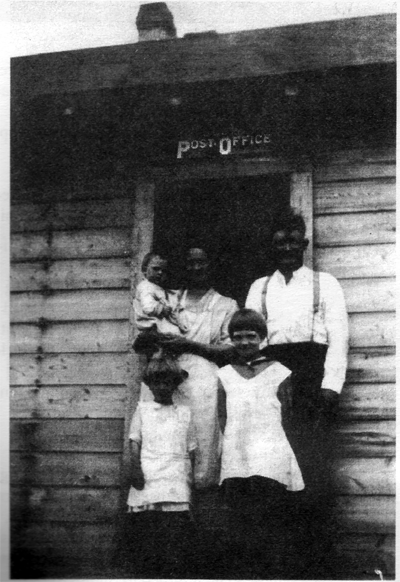
Juntunen and Perry Hanson. The Suomi post office was established in 1921, and
Mrs. Urho Rikala was appointed postmistress. The postal authorities had
protested using the name "Suomi," and the name did lead to considerable
confusion. According to Gust Saari, Sr., who was later postmaster, mail,
which was really destined for the country of Finland, was sent there
from everywhere in the United States, even from Asia and Africa. When
the M&R Railroad ceased operations, the mail was brought to Marcell by
Homer Helm and picked up by the Suomi postmaster from Marcell. In 1938,
Deer River Route 1 was established and Milton Wolfe began driving
directly through Suomi, delivering mail to individual mailboxes.
Until 1929 when telephone lines were extended to Suomi, people walked to
McVeigh's Landing, which had the nearest telephone when emergencies
occurred. Ailie Mackley describes those telephone party lines: "It was
almost like TV. Everybody knew what the rings were for each family and
some families were more talkative, so people knew when to listen in." A
Suomi Co-op Telephone Association was organized and began operating in
1948. In June, 1962, dial telephone service came to Suomi. After World
War II, the REA began extending electric service to rural communities,
and Suomi received electric power in 1946.
At various times the community had a Suomi Purchasing Co-op, a Suomi
Workers' Club, a temperance movement, and a Suomi chapter of the
Minnesota Finnish-American Historical Society.
The settlers engaged chiefly in dairy farming and also did some logging.
They had a few cows, sold cream to town creameries, and raised gardens
for their own use. Rikalas had a store where staples could be purchased.
Cream was transported to creameries by the M&R and later was picked up
by truck. These Finns were active in establishing the Deer River
Farmer's Co-operative Exchange, which also had a creamery. The Co-op
truck drivers not only picked up cream on a regular basis but also took
their orders for groceries, hardware, and whatever else was needed,
including liquor and baby diapers at times. The drivers then delivered
these supplies the next time cream was picked up.
Ailie Mackley doesn't remember ever going to a doctor when she was a
child. Doctors struggled through the roads in case of emergencies. Mrs.
Jaffet Heikkinen and Mrs. Matt Lekander were midwives and delivered many
babies.
Neighbors visited each other a lot. Those were the days people just
dropped in. "Our home was just a regular hotel," said Miriam. The
community had dances, basket socials, and played games. There was the
Summer Festival (Juhannus) at the church, New Year's Eve when they
melted and poured lead and told fortunes, Luther League, and Christmas
programs at school. There were fishing, hunting and picnics. For many Finns, Saturday night was a time for
socializing as visitors came for sauna and coffee. Ailie Mackley
described the first saunas with stoves made of rocks. There was no
chimney, and the walls and everything got smoky. You got dirty again if
you touched the walls. Later saunas were built with chimneys and the
soot was no longer a problem. Miriam Payne remembers people thinking it
was so strange when she would tell them of friends coming over for a
bath! Miriam Hokkanen Payne grew up in a family of girls and
had to do all types of work. Chores included carrying in wood, cleaning
out ashes, and pitching hay and manure. "We had to take the cows to the
different pastures," she said. "In the morning our mother would wake us
up, hand us half an orange and away we'd go and get the cows. We'd milk
by hand. And we used to sing. I always remember being on the hay load,
with horses, of course, and dad would be singing and my twin and I used
to sing. Mother always sang when she worked." The Hokkanens had a pump
organ and the teachers who boarded at the Hokkanens gave music lessons.
There were lots of books and � they loved reading. There are approximately eight lakes in area. Emil
Hokkanens had a resort on Grave Lake, and Waimeno Anttila had one on
Little Bowstring. For many years, the Poenix farm and resort (originally
the Anttila farm) served as the site of an annual field trip for grade
school students who came to see the buffalo. The big barn is gone, the
resort remains, and Bob Poenix continues to raise a few of these animals
that can be seen grazing. Little Bowstring and Grave Lakes are dotted
with homes. Former residents who left to make their way in the world
have retired and have returned to the hills of Suomi country.
The dairy farming in Suomi was finished when Oliver Juntunen changed to
raising beef cattle. Like his father before him, Oliver will be passing
farm place down to his son Dale and will move into a new home on the
shore of Grave Lake. In the pioneer days, there were few non-Finns Iiving
in Suomi. Now this community, like all others, is a melting pot of
nationalities. There are not many that speak Finnish anymore, but some
speak English with a hint of Finnish. "Suomi is unique because it is the
only place in the county where no one has an accent", joked Oliver
Juntunen. That first generation of Finns who made their homes in Suomi
has passed on, but one can look at the hills, trees, and lakes and
understand why they chose this spot for their home. From the Deer River Area Centennial
History - 1998
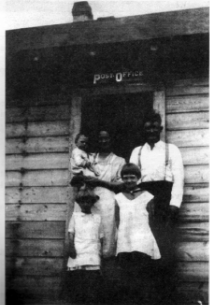
Suomi Post Office - Rikala Store
Clockwise: baby Evelyn, Hilda,
Urho, Eleanor, and Irene Rikala
Deer River Area Centennial History |
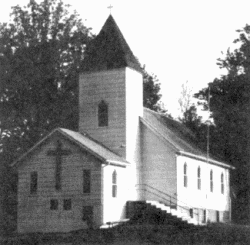
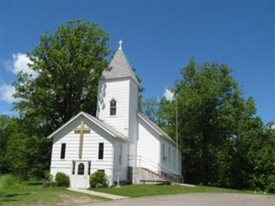
Suomi Church - 1997
Deer River Area Centennial History |
From Pines, Mines and Lakes - The Story of
Itasca County - 1960: The very last area in Itasca County to be
settled was the Suomi district around Grave Lake and Little Bowstring
Lake. Few, if any, settled there before 1916. Most of the present Suomi
farmers bought their land about then from the Pellervo Land Company of
Duluth, a company organized in 1914 by Mr. Antero Havela and Mr. John
Asiala. The company at the time were simply land agents. Later they went
into logging and banking. They had procured the rights to sell the lands
of the Itasca Lumber Company. Both men were Finnish, could not speak
English fluently, and consequently advertised in Finnish newspapers and
attracted the Finnish people who now live there. People today look upon Mr. Havela as the
founder of the Suomi community. He was robust and good-natured and knew
how to sell the land. He was instrumental in bringing first preacher to
Suomi and in getting the Suomi church started. Among the first settlers who came here
1916 were Otto Salo, Edwin Juntenen, Japhet Heikkinen, Edward Heikkinen,
Oscar Maki, Nestor and Richard Wierimaa. Salo and Juntenen and the two Heikkinens
logged on the west side of Bowstring lake during that first winter of
1916-17. They lived a way east of the lake in a little log cabin on the
Heikkinen's farm; Heikkinen's oldest daughter Annie did the cooking for
them. In the summer of 1917 the Heikkinens built the the house that is
still the home of Rueben Heikkinen and his family. Juntenen and Maki
also built their houses that summer. Their families moved in as soon as
the homes were completed. When these people built their homes they
had their difficulties. Lumber, for the roof, for the floors and windows
and for door frames in the Heikkinen home, was carried on the men's
shoulders the 2� or three miles to the Heikkinen farm from the Suomi
station just west of Grave Lake. That summer of 1917 two heavy cast iron
kitchen stoves were pulled from the station to the homes on sleds.
Others who moved into the area in 1917
were the Henry Kela, the Jalmer Kolu and the Oscar Haapamaki families as
well as Edward Mattson and Nick Huju. The Filpus, the Koivulas, the Gust
Saaris, the Jack Makis and Gust Wuorio moved in in 1918. The Anttilas
came in 1919. The first child born in Suomi was Mildred Juntenen, now
Mrs. Perry Hanson of Spruce Park. She was also the first child baptized
at the Suomi church. In the next two or three years more and
more settlers moved in. A few of them have moved to Marcell and Jesse
Lake and even out of the state, but most of them have remained. Most of the Suomi land was cut-over land
full of stumps and brush. The first job of the settlers was to clear
brush and dig out stumps. Often crops were planted between the most
ornery and biggest stumps. A lot of sweat and a lot of dynamite were
needed to get those stumps out. Year by year more and more of the stumps
were removed. Today the Suomi district has some of the finest farm land
in Itasca County. The Finns at Suomi have been unusually
cooperative within their group. They organized the Suomi Purchasing Coop
in 1919 to buy necessary supplies in larger quantities at wholesale
prices. A few years later this cooperative became affiliated with the
Deer River Farmers' Exchange and the Central Cooperative Exchange of
Superior, Wisconsin. Pines, Mines and Lakes - The Story of
Itasca County
� 1960 James E. Rottsolk and the Itasca County Historical Society
Post Office:
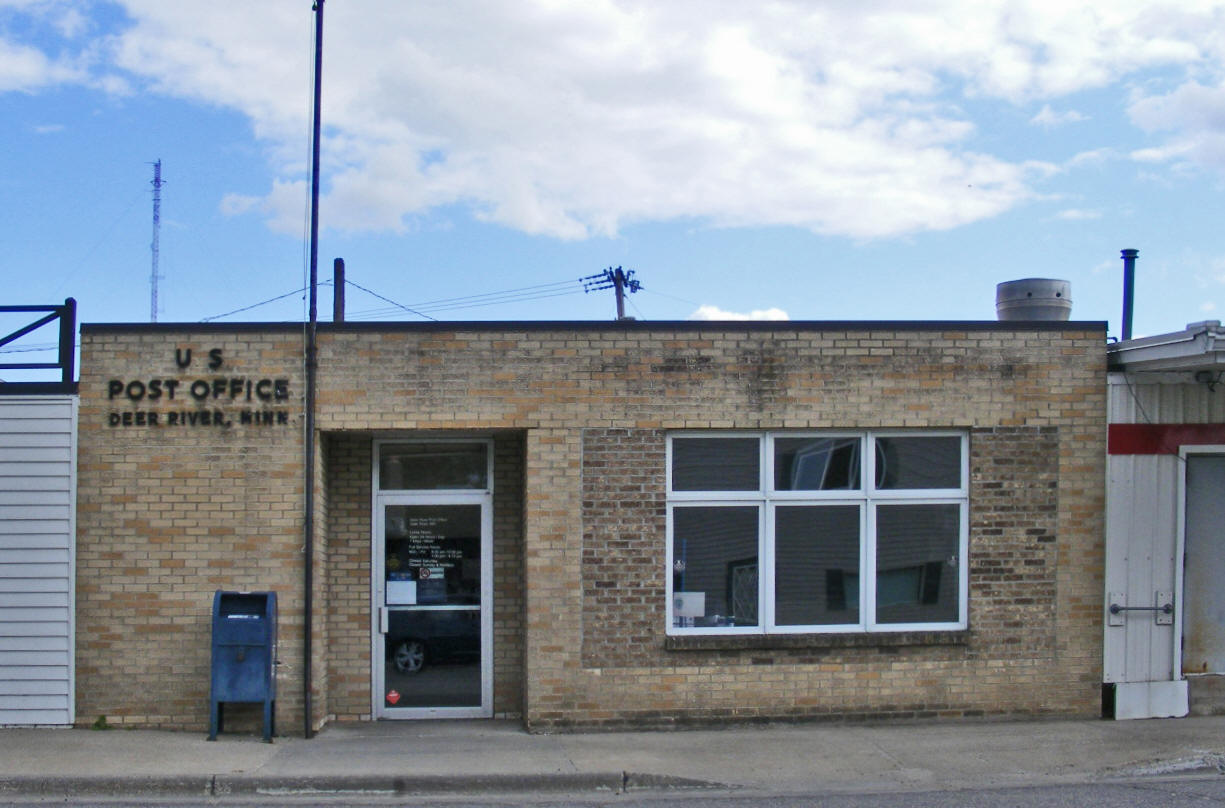
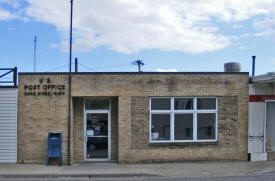
Many years ago Suomi had a post office. Today, the area is served
by the Deer River Post Office.
US Post Office
12 1st Avenue NE
Deer River, MN 56636
Phone: (218) 246-8440
Toll Free: (800) ASK-USPSRegular Business Hours:
Week Days
8:30 am - 12:00 pm
1:00 pm - 4:15 pm
Saturday
Closed
 
|
 |
News:
Weather:
Map:
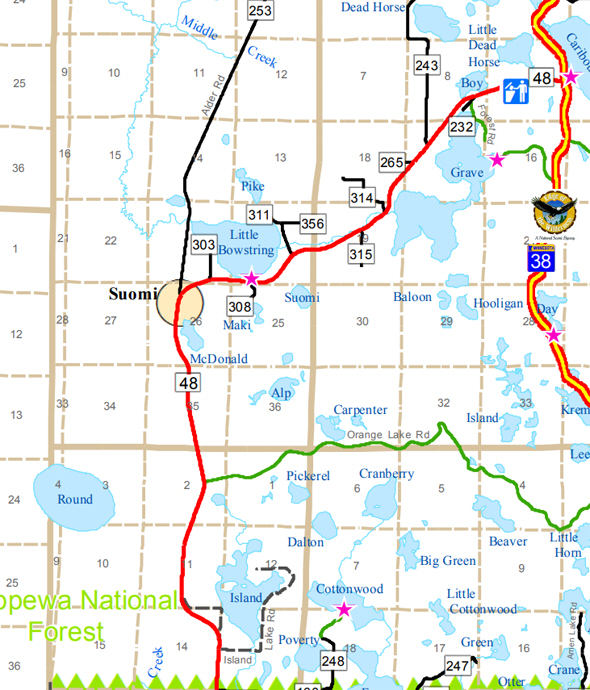
Suomi Minnesota area -
Itasca County Highway map
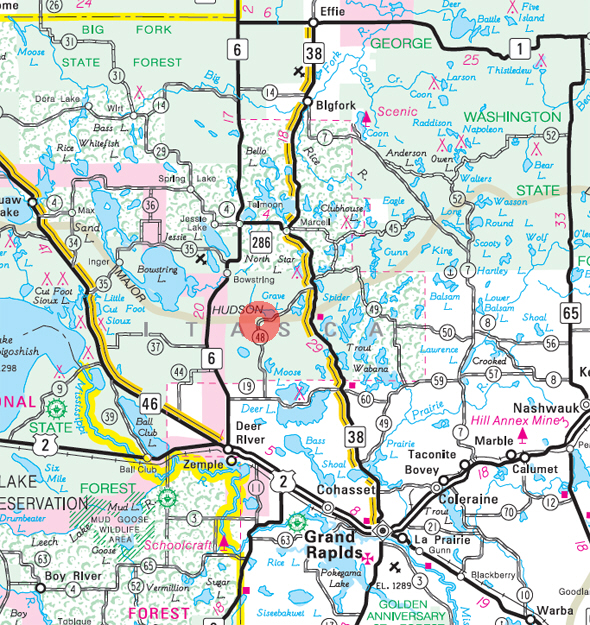
Minnesota State
Highway Map of the Suomi Minnesota area
Events:
Attractions:
Recreation:
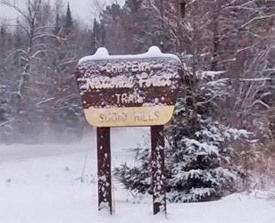
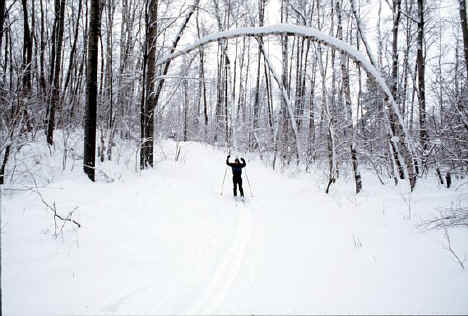
Suomi Hills Ski Trail
49554 State Hwy 38
Marcell, MN 56657
Phone: (218) 832-3161
The
Suomi Hills Recreation Area is named for the small Finnish
community of Suomi, situated on the northern edge of the Suomi
Recreation Area located near Grave Lake, Minnesota. area was
logged from 1905 to 1910, with people settling in the area about
1916. Civilian Conservation Corps (CCC) camp, prisoner of war
camp during World War II is located on the north end of Suomi
Hills.
Suomi Hills has 21 miles of trail, numerous
small lakes and several primitive campsites for day or overnight
hiking, biking, skiing and canoe trips. The rolling topography
offers cross-country and mountain bike trails for intermediate
and advanced skiers and bikers. groomed and track-set in the
winter and mowed in the summer. basswoods and scattered pine
form the landscape of the area. Several Lakes such as Adele,
Spruce Island, Big Horn and Hill offer good bass and pan
fishing. Brown trout can be caught in Lucky Lake and Rainbow
Trout in Kremer Lake.

|
 |
| |
|

|
Lakes:
Schools:
Grave Lake School closed in 1949, since then, students
have been bussed into Deer River.
Churches:
Suomi Evangelical Lutheran Church
- ELCA
42935 County Road
48
Deer River, MN 56636
Phone: (218) 832-3883
Pastor: Sue Johnson
Sunday Service: 10:30 am


We
are part of the Northeastern Synod of the
Evangelical Lutheran Church in America. Jesse
Lake has been providing a Word and Sacrament
ministry since 1909 (Swedish Pilgrim
Church�1909-1940 & Zion (Norwegian) Lutheran Church
from 1917-1940) & Suomi (Finnish) was founded in
1918 to bear witness to the saving grace of Jesus
Christ. Both congregations continue to extend God�s
Word of hope and healing to the communities they
serve. |
 |
Media:
Motels:
Resorts:
Campgrounds:
Businesses:
Aerial Photo:
Topographic Map:
[click image to enlarge, zoom in or zoom out]
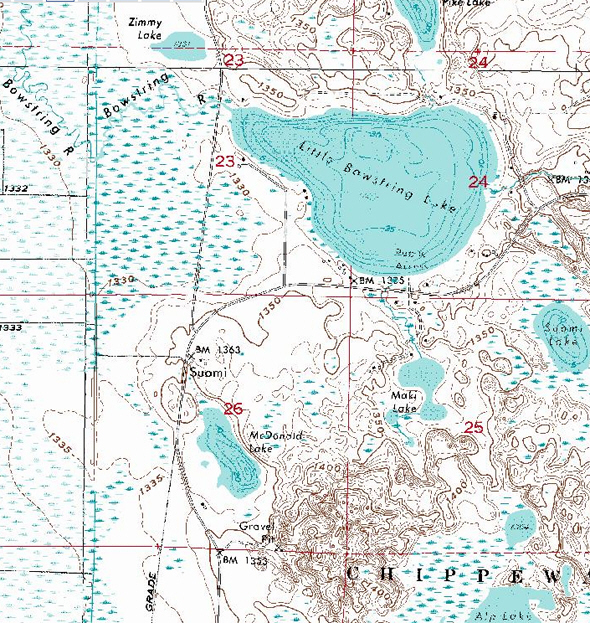 Topographic map is courtesy of the Minnesota DNR - click map to zoom or enlarge
|
|