|
Navigation
LakesnWoods.com
Home
Page
Contact Us
Privacy
Minnesota History Shop
Visit The Minnesota History Shop
www.minnesotahistoryshop.com
Historic maps
Historic books
Historic framed art
Historic
postcards
Clothing with historic
images
And much more!!! |
Meadowlands Guide:
Location
Geography
Demographics
History
Government
Post Office
News
Weather
Street Map
Events
Attractions
Recreation
Lakes
Health Care
Schools
Churches
Media
Motels
Resorts
Campgrounds
Businesses
Aerial Photo
Topographic Map © 2004-2024
LakesnWoods LLC
All Rights Reserved
DCMA, Defamation, Copyright and Trademark Infingement Policy
|
WANTED! Do you have photos, historical accounts or
other items pertaining to the Meadowlands area? Would you like to
share this historical information with the world?
LakesnWoods.com would like to publish your Meadowlands photos
(current or historical) or historical accounts on this website.
Original materials can be returned and your privacy will be
respected.
Contact us |
|
Meadowlands Minnesota Community Guide
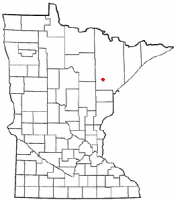
Location:
Population:
| Meadowlands (city) |
1970 |
1980 |
1990 |
2000 |
2010 |
2000-2010 Change |
| Actual |
Percent |
| Population |
128 |
135 |
92 |
111 |
134 |
+23 |
+20.72 |
| Land Area (sq. mile) |
0.40 |
0.34 |
0.38 |
0.38 |
0.39 |
+0.01 |
+2.63 |
| Density (persons per sq. mile) |
320.00 |
397.06 |
242.11 |
291.05 |
343.59 |
+52.54 |
+18.05 |
| Housing Units |
49 |
63 |
56 |
61 |
78 |
+17 |
+27.87 |
| Households |
-- |
58 |
40 |
53 |
67 |
+14 |
+26.42 |
| Persons Per Household |
-- |
2.33 |
2.30 |
2.09 |
2.00 |
-0.09 |
-4.31 |
Geography:
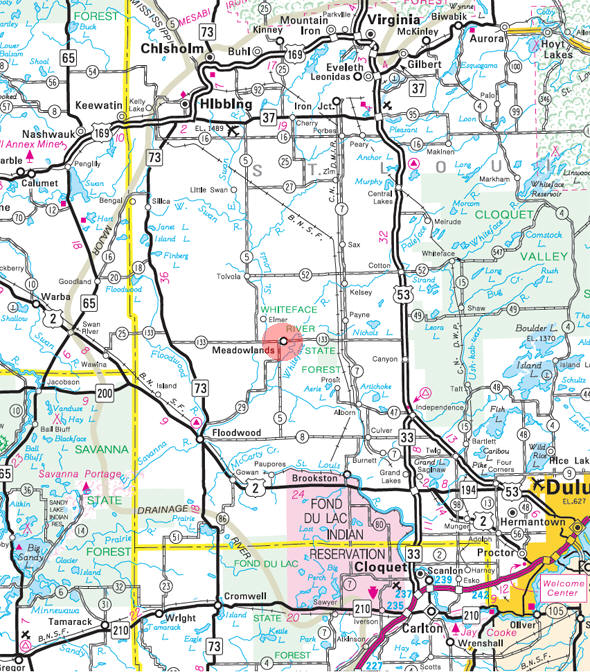
Meadowlands is a city in Saint Louis County,
Minnesota. Saint Louis County Highway 133 (CR 133), County 5 (CR 5), and
County 29 (CR 29) are three of the main routes in Meadowlands. According
to the United States Census Bureau, the city has a total area of 0.39
square miles (1.01 km2), all of it land. The elevation is 1,276 feet
(389 m).
From
Wikipedia, the free
encyclopedia.
Demographics:
As of the census of 2010, there were 134 people, 67
households, and 33 families residing in the city. The
population density was 343.6 inhabitants per square mile
(132.7/km2). There were 78 housing units at an average
density of 200.0 per square mile (77.2/km2). The racial
makeup of the city was 94.0% White, 3.7% African
American, 0.7% Native American, and 1.5% from two or
more races.
There were 67 households of which 23.9% had children
under the age of 18 living with them, 29.9% were married
couples living together, 16.4% had a female householder
with no husband present, 3.0% had a male householder
with no wife present, and 50.7% were non-families. 50.7%
of all households were made up of individuals and 32.9%
had someone living alone who was 65 years of age or
older. The average household size was 2.00 and the
average family size was 2.82.
The median age in the city was 47 years. 23.9% of
residents were under the age of 18; 9% were between the
ages of 18 and 24; 14.9% were from 25 to 44; 25.4% were
from 45 to 64; and 26.9% were 65 years of age or older.
The gender makeup of the city was 43.3% male and 56.7%
female.
From
Wikipedia, the free
encyclopedia.
History:
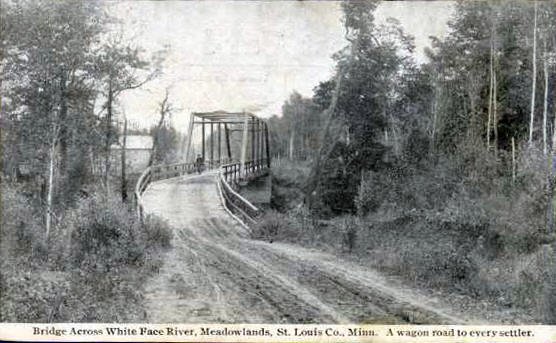
MEADOWLANDS Township (T. 53N, R. 19W) has a tract of
natural mowing and farming land, called meadows, adjoining the White
Face River and giving the name of the railway village and the township,
but much of its area consists of extensive swamps, called muskeg. The
city in section 15 was incorporated as a village on October 15, 1924;
the post office began in 1906; it had a Duluth, Missabe and Iron Range
Railroad station. Courtesy
Minnesota Historical Society
|
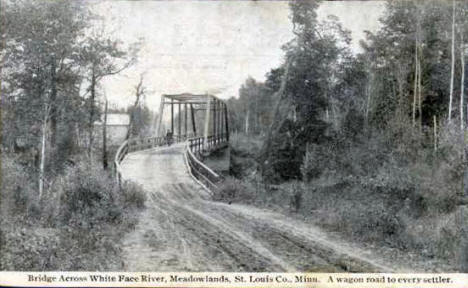
Bridge across White Face River, Meadowlands
Minnesota, 1909
LakesnWoods.com Postcard and Postcard Image Collection
Visit The
Meadowlands Photo Gallery for more recent and historic area
photos |
Government:
Post Office:
Utilities:
Major
Employers:
|
Employer |
Products/Services |
Employees |
|
n/a |
News:
Weather:
Map:
Events:
Central St. Louis
County Fair
3rd weekend in August
For more than 100 years the
Central St. Louis County fair has brought fun to the country!
Events include Sunday parade, live music, kickball tournament,
craft show, Annual River to River 5K run/walk, street dance and
so much more. There is no admission charge for the fairgrounds.
Purchase a $1 fair button to enter the fair building and be
registered to win 100s of prizes! Some fair events may have
their own registration/admission fees.


 |
 |
Attractions:
Recreation:
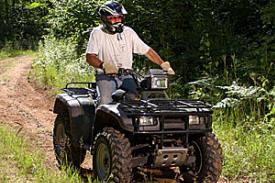
Alborn-Pengilly Trail
This 39-mile trail follows an
old abandoned railroad grade between the cities of Pengilly and
Alborn in northeast Minnesota. Traveling through wooded bogs and
upload forests, riders cross old railroad trestles that offer
scenic views of the streams and rivers below. The flat grade and
little terrain variation are ideal for beginners. Trail
maintenance is provided by Itasca County and the Range Riders
ATV Club.
 |
 |
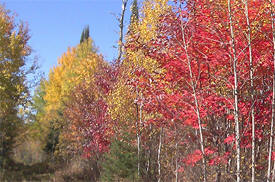
Whiteface River State Forest
The Little Whiteface River
Wildlife Area (WMA) borders the north side of the forest. This
WMA is mostly a wet, lowland area and is difficult to access.
There are no campgrounds within the forest. However, dispersed
camping is allowed, and campgrounds are available at both
Savanna Portage State Park and Indian lake Campground located in
the Cloquet Valley State Forest.
|
 |
Lakes:
|
Lake Name |
Size
(acres) |
Location |
Lake info |
Lake Map |
Rec Map |
Topo Map |
|
|
|
|
 |
|
|
|
Health
Care:
Schools:
Churches:
Christian Way Fellowship
9996 Elm Street
Meadowlands, MN 55765
Phone: (218) 427-2397
Pastor: Lloyd and Joanne
Olds
Sunday Service: 10:00 am
 |
|
First Lutheran Church - ELCA
7734 Central Avenue
Meadowlands, MN 55765
Phone: (218) 427-2636
Pastor: Dave Erdmann
Sunday Service: 10:30 am
|
|
Jehovah's Witness Kingdom Hall
7706 County Road 229
Meadowlands, MN
55765
Phone: (218) 427-2671
Pastor: n/a
Sunday
Service: n/a
|
|
St. Mary's Catholic Church
9999 Highway 133
Meadowlands,
MN 55765
Phone: (218) 427-2626
Pastor:
Rev. Pio Atonio
Sunday Service: 8:00 am
|
|
Media:
Motels:
Resorts:
Campgrounds:
Businesses:
(The) Hummingbird
7704 Cole Avenue
Meadowlands, MN
55765
Phone: (218) 427-2294
|
|
Kelly Maly Screen Printing
7826 County Road 226
Meadowlands, MN 55765
Phone: (218) 427-2419
|
|
Kerri's Cell Phone Accessories
9972 Highway 133
Meadowlands, MN 55765
Phone: n/a
|
|
Lahti Farms
10791 Arkola Road
Meadowlands, MN
55765
Phone: (218) 427-
|
|
Larson Forge & Finish
7695 Highway 47
Meadowlands, MN 55765
Phone: (218) 427-2381

|
|
Little Moose
Painting
6818 Highway 29
Meadowlands, MN 55765
Phone: (218) 213-8682
For over 20 years we have
served the northern Minnesota area, providing honest friendly
service and exceptional attention to detail. For your painting
needs, whether interior or exterior, residential or commercial
Little Moose Painting is here to help. We cover a vast area
including; the North Shore, Iron Range, Brainerd Lakes region,
I-35 Corridor, and northwestern Wisconsin. What that means is
from Grand Marais to Forest Lake, and Brainerd to Bayfield
Little Moose Painting can take care of your paint job.
|
 |
Main Idea Creative Marketing & Design
9669 Crooked
Creek Road
Meadowlands, MN 55765
Phone: (218) 427-2350
|
|
Meadowlands Ambulance Service
9955 Highway 133
Meadowlands, MN 55765
Phone: (218) 427-2236
|
|
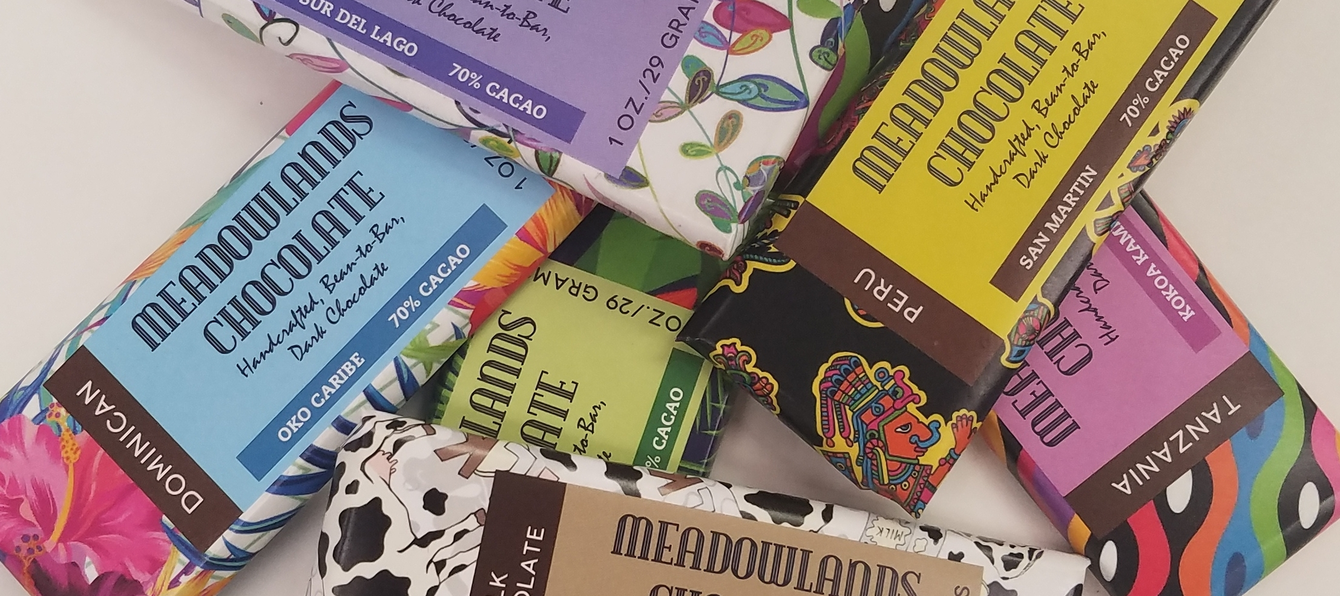
Meadowlands
Chocolate
10431 Bachelor Square
Meadowlands, MN
55765
Phone: (612) 708-5046
Our NEW D'Origenn Columbia
Huila 70% Chocolate, made with Del Fonce Evaporated Cane Sugar,
will be available soon! Handcrafted, bean-to-bar chocolate that
will make your taste buds sing and your body smile.
|
 |
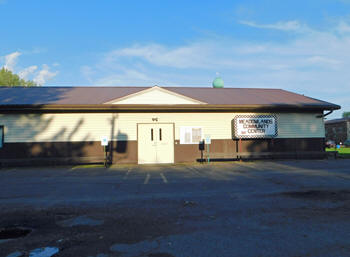
Meadowlands Community Center
7758 Western Avenue
Meadowlands, MN 55765
Phone: (218) 427-2394
|
|
Meadowlands Manor
7727 Scott Avenue
Meadowlands,
MN 55765
Phone: (218) 427-2665
|
|
Meadowlands Studio
10431 Bachelor Road
Meadowlands, MN 55765
Phone: (218) 260-6767
Handmade, beautiful and
functional stoneware pottery by Clyo Howard and handmade copper
garden art by Beryl Wells Hamilton.
|
|
Northwood Organics
8402 Highway 5
Meadowlands, MN
55765
Phone: (218) 427-2560
|
|
Riversideknits
7998 N Dart Road
Meadowlands, MN
55765
Phone: (218) 427-2371
I'm a home based business
operation. Who's passionate about knitting and have mastered the
technique of stranded knitting, which includes intricate
patterns in my designs.
|
|
Schneiderman's
Furniture Inc
7727 Central Avenue
Meadowlands, MN
55765
Phone: (218) 427-2123
Schneiderman's Furniture
offers a vast selection of top quality to heirloom quality
pieces with the unique opportunity to customize the color,
texture and textile of just about every item to reflect your
personal style. As you'd expect, we carry the most respected and
finely crafted names in furniture, including King Hickory,
Ekornes Stressless, Sealy, Natuzzi, Flexsteel, Sam Moore and
countless others. And our inventory complements every room in
your home, from living room to dining room, bedroom, home
office, outdoor spaces and even home accents for the in between
spaces such as landings, foyers and hallways.
|
|
Shaving Maker Custom Planing Inc
9857 Davidson Road
Meadowlands, MN 55765
Phone: (218) 427-2228
|
|
Trailside Lounge & Grill
9994 Spruce Street
Meadowlands, MN 55765
Phone: (218) 427-2773
The Trailside is a family
owned business that welcomes you to enjoy wonderful food,
excellent service, and an atmosphere where you can be
comfortable bringing your family in!

|
|
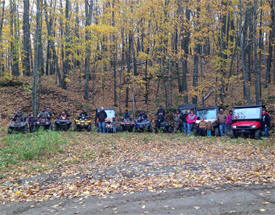
Twin River Riders ATV Club
PO Box 107
Meadowlands, MN 55765
|
 |
Victory
Coffeeshop
7719 Central Avenue
Meadowlands, MN
55765
Phone: (218) 427-1028
Victory Community Partnership
is a non-profit organization formed to help our community of
Meadowlands, MN and outlying areas by providing a gathering
place for all ages. We hope to provide a warm and comfortable
place to grab a bite to eat, drink GOOD coffee and espresso, and
just hang out. We also plan to offer a small selection of
groceries, a library service, community education classes, and
projects for kids of all ages.
|
|
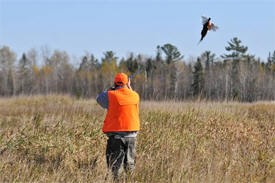
Wild Experience Hunting Preserve
6964 Highway 29
Meadowlands, MN 55765
Phone: (218) 427-2487
Wild Experience Hunting
Preserve is located just 5 miles southwest of Meadowlands, MN
and is open for spring and fall hunting. Our season is from
Labor Day through Memorial Day. We remain open throughout the
winter months depending on snow conditions. Guided Hunts are
available, or challenge your dog on a wide variety of habitat on
our 400 acre preserve. You'll find corn rows, sorghum, grass and
light to heavily wooded fields that give you different levels of
difficulty to choose from.
|
 |
Aerial Photo:
Topographic Map:
[click map to enlarge, zoom in or zoom out]
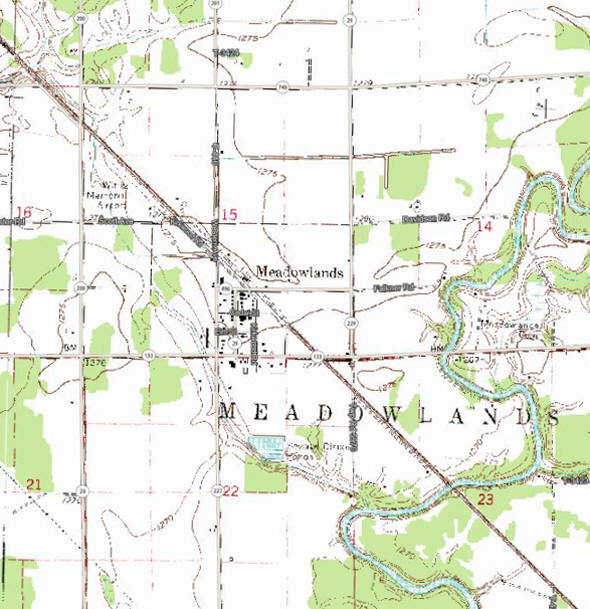 Topographic map is courtesy of the Minnesota DNR
-
click map to zoom or enlarge
Topographic map is courtesy of the Minnesota DNR
-
click map to zoom or enlarge |
|