|
Navigation
LakesnWoods.com
Home
Page
Contact Us
Privacy
Minnesota History Shop
Visit The Minnesota History Shop
www.minnesotahistoryshop.com
Historic maps
Historic books
Historic framed art
Historic
postcards
Clothing with historic
images
And much more!!! |
Kinney Guide:
Photo Gallery
Location
Geography
Demographics
History
Government
Post Office
News
Weather
Street Map
Events
Attractions
Recreation
Lakes
Health Care
Schools
Churches
Media
Motels
Resorts
Campgrounds
Businesses
Aerial Photo
Topographic Map © 2004-2024
LakesnWoods LLC
All Rights Reserved
DCMA, Defamation, Copyright and Trademark Infingement Policy
|
WANTED! Do you have photos, historical accounts or
other items pertaining to the Kinney area? Would you like to
share this historical information with the world?
LakesnWoods.com would like to publish your Kinney photos
(current or historical) or historical accounts on this website.
Original materials can be returned and your privacy will be
respected.
Contact us |
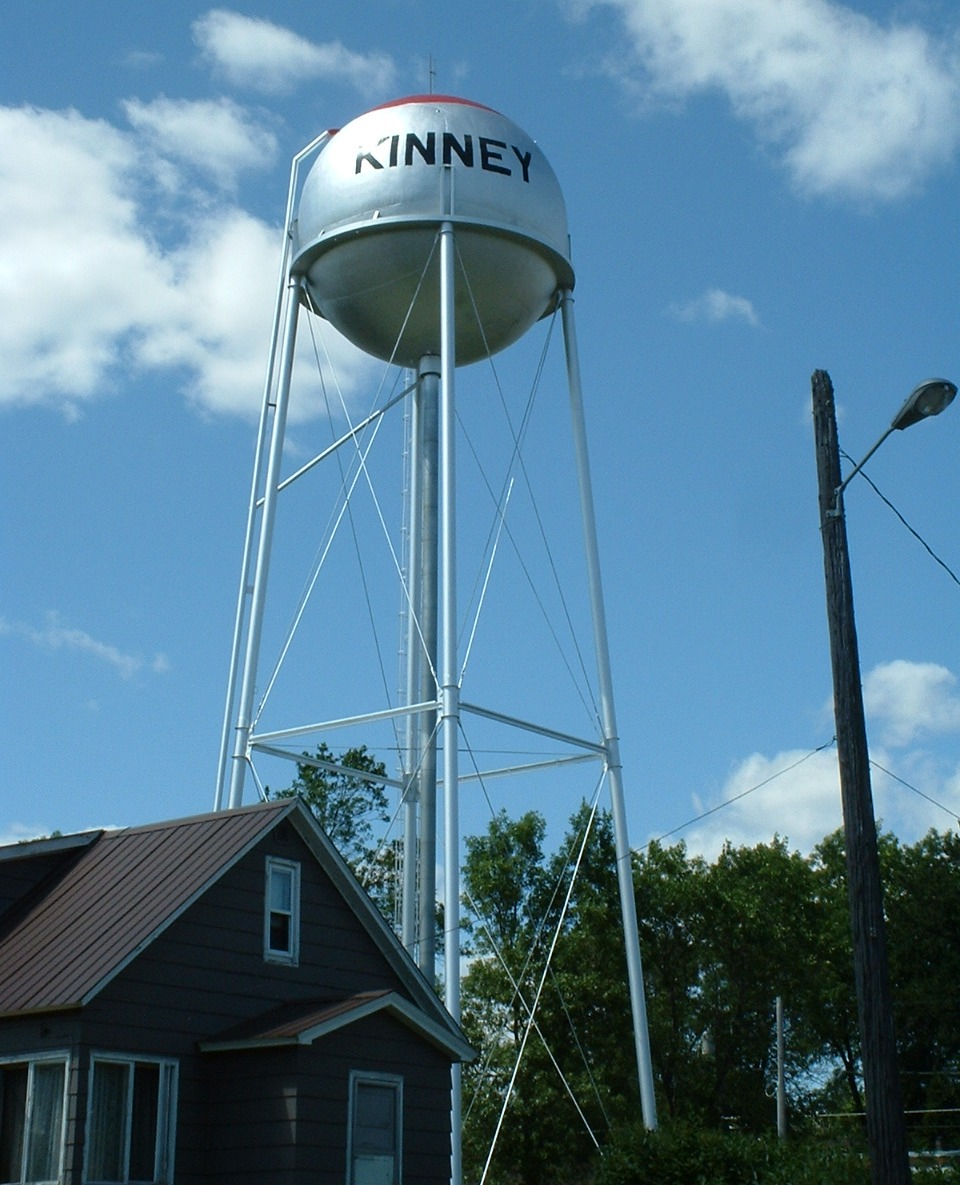
Kinney Water Tower
Click to enlarge
|
Kinney Minnesota Community Guide
Location:
Population:
| Kinney (city) |
1970 |
1980 |
1990 |
2000 |
2010 |
2000-2010 Change |
| Actual |
Percent |
| Population |
325 |
447 |
257 |
199 |
169 |
-30 |
-15.08 |
| Land Area (sq. mile) |
n/a |
n/a |
n/a |
4.85 |
4.62 |
-0.23 |
-4.74 |
| Density (persons per sq. mile) |
n/a |
n/a |
n/a |
41.0 |
36.6 |
-4.4 |
-10.73 |
| Housing Units |
n/a |
n/a |
n/a |
88 |
83 |
-5 |
-5.68 |
| Households |
n/a |
n/a |
n/a |
82 |
70 |
-12 |
-14.63 |
| Persons Per Household |
n/a |
n/a |
n/a |
2.40 |
2.41 |
+0.01 |
-0.42 |
Geography:
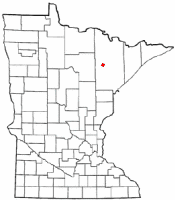
Kinney is a city in St. Louis County, Minnesota.
Nearby US Highway 169 serves as a main arterial route in the community.
According to the United States Census Bureau, the city has a total area
of 4.83 square miles (12.51 km2); 4.62 square miles (11.97 km2) is land
and 0.21 square miles (0.54 km2) is water. The
elevation is 1,542 ft (470 m) above sea level.
From
Wikipedia, the free
encyclopedia.
Demographics:
As of the census of 2010, there were 169 people, 70
households, and 43 families residing in the city. The
population density was 36.6 inhabitants per square mile
(14.1/km2). There were 83 housing units at an average
density of 18.0 per square mile (6.9/km2). The racial makeup
of the city was 97.6% White, 1.2% Native American, and 1.2%
from two or more races.
There were 70 households of which 32.9% had children
under the age of 18 living with them, 45.7% were married
couples living together, 8.6% had a female householder with
no husband present, 7.1% had a male householder with no wife
present, and 38.6% were non-families. 27.1% of all
households were made up of individuals and 7.2% had someone
living alone who was 65 years of age or older. The average
household size was 2.41 and the average family size was
2.88.
The median age in the city was 40.1 years. 22.5% of
residents were under the age of 18; 8.8% were between the
ages of 18 and 24; 24.2% were from 25 to 44; 33.1% were from
45 to 64; and 11.2% were 65 years of age or older. The
gender makeup of the city was 52.1% male and 47.9% female.
History:
Kinney, a city in section 15, Great Scott Township (T.
58N, R. 19W), incorporated as a village on November 11, 1910, was named in
honor of O. D. Kinney, a discoverer of the iron mines of Virginia and a
founder of that city. The post office began in 1907. Courtesy
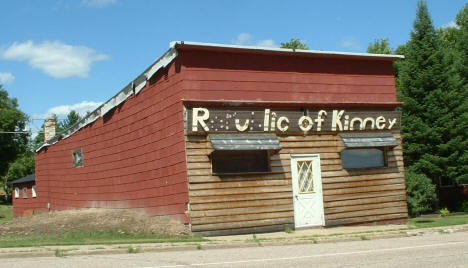
Minnesota Historical Society Republic of Kinney
1978 Republic of Kinney Passport, 0046 By 1977, the City of
Kinney, with a population of 325 according to the 1970 census, suffered from
a failing water system, and was faced with a staggering replacement cost of
$186,000. After numerous unsuccessful attempts to secure funding from state
and federal agencies due to bureaucratic red tape, agencies such as:
Department of Housing and Urban Development (HUD), the Federal Housing
Authority (FHA), and the Iron Range Resources and Rehabilitation Commission
(IRRRC), the city council was lead to believe that it would be easier to
receive foreign aid if Kinney seceded from the union, declared war, and lost
immediately. Mayor Mary Anderson and a supportive Kinney City Council sent
the following July 13, 1977, 'tongue-in-cheek' secession letter to U.S.
Secretary of State Cyrus Vance.
City of Kinney
Clerk’s Office
KINNEY, MINNESOTA 55758
July 13, 1977 Honorable Cyrus Vance
Secretary of State
Washington, D.C. BE IT RESOLVED that the City Council of the
City of Kinney, in Kinney, Minnesota, has decided to secede from
the United States of America, and become a foreign country. Our
area is large enough for it. We are twelve square blocks, three
blocks wide and four blocks long. We will be similar to Monaco.
It is much easier to get assistance as a foreign country, which
we need badly, and there is no paper work to worry about. If
necessary, we will be glad to declare war and lose. However, if
this is a requirement, we would appreciate being able to
surrender real quick, as our Mayor works as a nurse in a
hospital, and most of our council members work in a nearby mine
and cannot get much time off from work. CITY COUNCIL OF VILLAGE OF
KINNEY Mary Anderson, Mayor
Margaret Medure, Clerk
Al Helmin, Councilman
Lloyd Linnell, Councilman
Myron Holcomb, Councilman
Jim Randall, Village Attorney |
The secession was never officially
acknowledged by Vance or the U.S. The news story broke locally in the Mesabi
Daily News on February 5, 1978, in an article by Ginny Wennen entitled "Move
over Monaco, here comes Kinney." The story garnered national and
international attention beginning on February 7, 1978, when the story was
featured on the NBC Nightly News with David Brinkley. Jeno Paulucci, a businessman based out of Duluth,
Minnesota, was the first to acknowledge the new republic and offer ‘foreign
aid’ in the form of a dark brown 1974 Ford LTD police squad car and 10 cases
of Jenos Sausage Pizza Mix on February 13, 1978. The squad car was painted
with a Republic of Kinney shield on the driver’s side that read “Commander
in Chief, Republic of Kinney,” and “Chief of Police, Kinney, MN.” on the
passenger side. In November 1978, the Iron Range Resources and
Rehabilitation Board (IRRRB) approved $198,000 grant, allocated in three
payments of $66,000 per year from the Taconite Area Environmental Protection
Fund, to repair the existing water system, construct cement runoff basins,
and install additional fire hydrants. The Republic of Kinney would go on to create and sell over
2,500 passports at $1.00 a piece, buttons, t-shirts, and even a summer
festival called ‘Secession Days’, which was first held during the weekend of
August 1&2, 1987.
The City of Kinney will celebrate the 30th Anniversary of its "independence"
as the Republic of Kinney during the weekend of July 13-15, 2007.
From
Wikipedia, the free
encyclopedia.
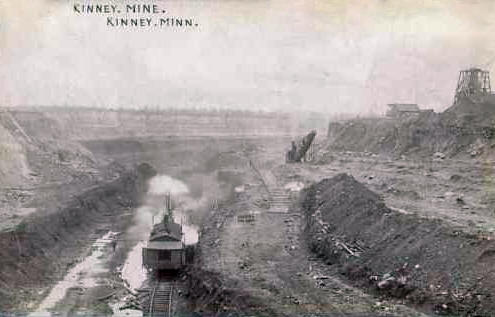
Kinney Mine, Kinney Minnesota, 1920s
LakesnWoods.com Postcard and Postcard Image Collection
Visit The
Kinney Photo Gallery for more recent and historic area
photos |
Government:
Post Office:
|
The post office in Kinney was established on February 27th, 1907 and
closed on April 12th, 2008 |
Utilities:
Major
Employers:
|
Employer |
Products/Services |
Employees |
|
n/a |
News:
Weather:
Map:
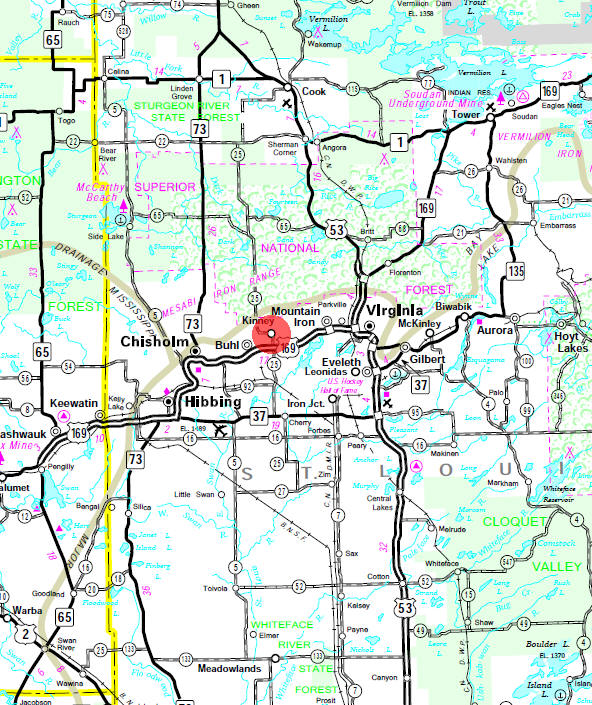
Minnesota State
Highway Map of the Kinney Minnesota area
Attractions:
Recreation:
|
Mesabi Trail
The
Taconite State Trail stretches 165 miles from Grand Rapids to Ely
and intersects with the Arrowhead State Trail just west of Lake
Vermillion. Portions are paved for biking and in-line skating. The
remainder of the natural surface trail is used primarily for
snowmobiling in the winter. The trail goes through a few areas that
have standing water in the summer, however portions of the trail are
suitable for horseback riding, hiking, and mountain biking.
The Taconite Trail winds through forests of birch
and aspen intertwined with pine, leading the visitor by many
isolated lakes and streams. From Grand Rapids heading north, you see
the impact of the taconite and iron mining industry. The northern
portion of the trail terrain is rolling and tree covered as it winds
through state and national forest land.
|
 |
Events:
Lakes:
|
Lake Name |
Size
(acres) |
Lake info |
Lake Map |
Rec Map |
Topo Map |
|
|
|
 |
|
|
|
Schools:
Churches:
Media:
| None locally. Served
by Hibbing area TV, radio and newspapers |
Business Directory:
Kinney Public Library
400 Main Street
Kinney, MN 55758
Phone: (218)
258-2232 |
|
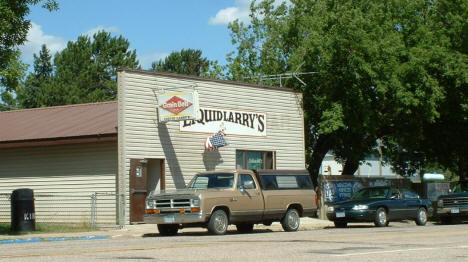
Liquid Larry's
401 Main Street
Kinney, MN 55758
Phone: (218)
258-2211 |
 |
Aerial Photo:
Topographic Map:
[click map to enlarge, zoom in or zoom out]
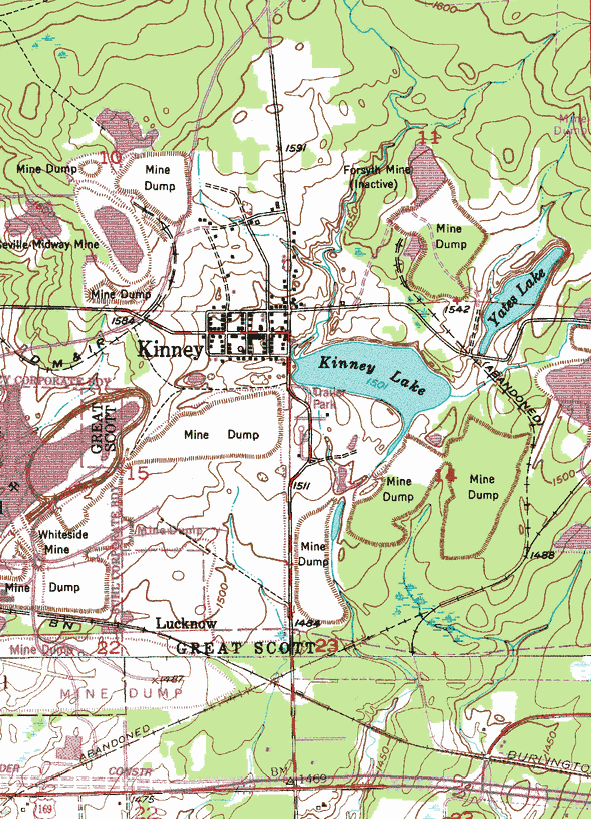 Topographic map is courtesy of the Minnesota DNR
- click map to zoom or enlarge
Topographic map is courtesy of the Minnesota DNR
- click map to zoom or enlarge
|
|